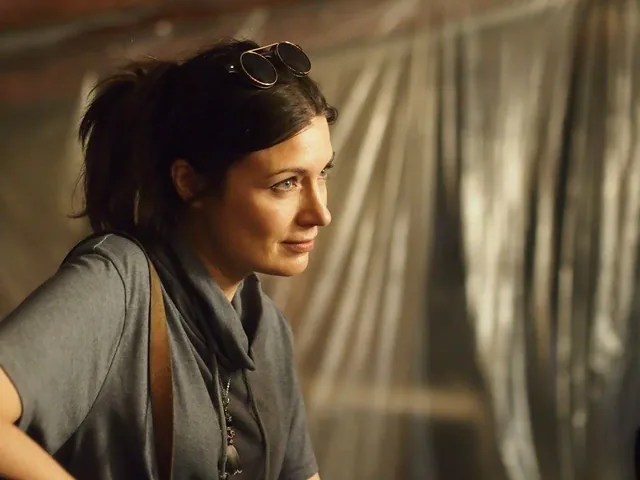
Olga Anikina
Poet, fiction writer,
translator & essayist.
Life and education
Olga Nikolaevna Anikina was born in Novosibirsk in 1976. She has lived in Moscow and Sergiev Posad and now lives in St. Petersburg.
She graduated from Novosibirsk Medical Institute and the Maxim Gorky Literary Institute. She holds the degree of Candidate of Medical Sciences and has practiced medicine since 1999.
She also pursued postgraduate studies in the Gorky Institute’s Department of Foreign Literature and took the professional development course “Translation from Yiddish,” led by Valery Dymshits, at the European University at St. Petersburg.
Writing and literary work
Her books include five poetry collections, two novels and a collection of short stories.
She helped establish the Antonovka 40+ Literary Prize and serves on its organizing committee. She edits the short prose section of the literary journal Emigrantskaya Lira.
She was a laureate of the Voloshin Competition in 2021. Her distinctions also include a diploma from the N. V. Gogol Literary Prize and recognition as a laureate of that prize in 2022.
Her work with our song projectsA new way into an old song
A melody can stay in a family even when its words become unfamiliar. Olga Anikina gives listeners another way into Jewish songs through Russian words they can understand, remember and sing.
Before 2017, Jewish songs were a small part of Olga’s wider literary work. She had created only a few remarkable Russian versions. An early version of her Hava Nagila appeared on her author page in 2009.
Her writing became a foundation of the project Еврейские песни. По-русски (Jewish Songs. In Russian), which Walter J. Kin initiated in 2017.
The life inside the words
In Olga’s Hava Nagila, joy has worn shoes and an open door. The singer has little money, knows regret, and still welcomes guests. Dancing becomes a way of answering life’s troubles.
In Handful of Happiness, the longing is just as tangible: happiness slips between the fingers, and a homeless heart searches for warmth.
These details reveal her literary craft. Her repertoire includes translation and freer reimagining, with new images and stories shaped for singing. The earlier songs remain the starting point; Olga’s Russian versions have a voice of their own.
From the page to a voice
In 2017, Walter J. Kin approached Olga with a proposal: translate and adapt at least 30 Jewish songs into Russian for two albums.
This began years of collaboration, resulting in more than 40 Russian translations and adaptations. Walter commissioned and financed the work and organised recordings. Olga gave the songs their Russian literary voice.
Yaroslav Olshevsky helped develop arrangements, sheet music and demos. Elechka brought many of the songs to listeners through her singing and guitar.
Olga’s words travel into English
For Jewish Songs. For All, Walter J. Kin adapts Olga’s Russian texts into English. Her particular images, humour and storytelling become the material for another act of songwriting.
Hear the connection in Ale Brider. Olga’s Russian version makes kinship concrete: greet a stranger, who may turn out to be your uncle, nephew or neighbour. Walter’s We Are Sisters We Are Brothers carries those encounters into English. Riglis Band performs both versions.
An earlier Yiddish song, Olga’s Russian reimagining and Walter’s English adaptation become distinct chapters of a continuing musical story.
A song someone else can carry
The ambition is to make room for new singers: a child discovering a melody, a family returning to a remembered song, an English speaker encountering Jewish music for the first time.
Olga’s contribution continues whenever her words are sung, recorded or carried into another language. Her writing gives the project a human scale: an open door, a greeting to a stranger, the wish for a little warmth.
Through this work, RIGLI hopes to help future generations find something they can make part of their own lives, and one day pass on.
Explore the songs